
Questions and answers
Bury St Edmunds Pet Shop FAQ: Your Questions Answered
Straight answers from our pet shop near Bury St Edmunds on visiting us, fish, reptiles, small pets and buying live animals responsibly. If yours isn't here, give us a call or message us on Facebook.
Fornham All Saints, just off the A14 near Bury St Edmunds. Open seven days.
Start here
The questions we hear most
What time are you open?
We're open seven days a week. Monday to Saturday, the doors are open from 9:30am to 5:30pm, and on Sunday from 10:00am to 4:00pm. For bank holiday hours, check our Facebook page or call 01284 703418 before you set off. You'll find us on Tut Hill in Fornham All Saints, about six minutes from Bury St Edmunds town centre.
What do you sell?
We sell tropical, marine and koi fish, coldwater and pond fish, exotic reptiles, rabbits and other small animals, and birds. We also stock supplies for dogs, cats and other pets, natural dog treats, and equipment for aquariums and ponds. Stock changes, so call or pop in to see what's in. Each range has its own page on this site, with what's worth knowing before you buy.
Which brands do you stock?
For aquariums and ponds we stock Juwel, Fluval, Oase, Aqua One, Eheim, JBL, Tetra, Hikari, NT Labs, Seachem, Evolution Aqua, D-D The Aquarium Solution, Red Sea, Tropic Marin, API, Kockney Koi, Cloverleaf and Bermuda, and we are an authorised TMC stockist for marine fish and corals. For reptiles we stock Exo Terra, Arcadia, ProRep, Komodo, Zoo Med and Habistat. For dogs, cats, small animals and birds we stock Burgess, Science Selective, Johnston & Jeff, CarniLove, Nutriment, Naked Dog Food, Little One, Marriages, Norfolk Pastures and JR Pet Products. Stock changes, so call 01284 703418 if you need a particular item.
Should I call before I visit?
You don't have to, but it helps if you're making a long journey or you're after something specific. Stock changes, so give us a ring on 01284 703418 and we'll tell you what's in before you set off. If you're interested in marine fish or corals, ask about ordering in from TMC's range while you're on the phone.
What if you haven't got what I'm after?
Ask. If it's something we can get, we'll order it in, take your phone number and call you when it arrives. If not, we'll suggest something similar that does the same job. Call 01284 703418 or pop in and tell us what you need.
Do you deliver, or can I phone ahead to collect?
No to both. We don't deliver, and we don't hold phone-ahead orders for collection. Everything is bought in the shop, so call 01284 703418 to check we have what you're after, then pop in. If it isn't in, we can order it and call you when it arrives.
Can I ask for advice before I buy a pet?
Please do. We'd rather you got it right than took the wrong animal home. Tell us about your home, your time and any pets you already have, and we'll talk through what suits. It's worth doing your own research too. Every animal needs the right space, diet and company, and many live for years, so it pays to choose slowly.
Hours and directions
Visiting us
Where are you, and how do I get there from the A14?
We're at Tut Hill, Fornham All Saints, Bury St Edmunds, Suffolk, IP28 6LE. Leave the A14 at the Fornham All Saints slip road, go straight over the double roundabout and on past the new housing estate, turn left at the third roundabout, then left again at the mini roundabout onto Tut Hill. The top of Tut Hill is closed, so please come in this way round. If your sat nav suggests a different way, follow these directions. It's roughly 3.6 miles, or typically six minutes, from Bury St Edmunds town centre.
How long does it take to reach you from nearby towns?
Typically, and off-peak, it's about 15 minutes from Ixworth, 17 from Mildenhall, 19 from Newmarket, 21 from Stowmarket, 23 from Thetford and 32 from Haverhill. Sudbury is about 32 minutes and Diss about 38. Allow longer at busy times. Our Visit us page has a drive-time table and routes, and each nearby town has its own page too.
Are you open on bank holidays?
Our regular hours are 9:30am to 5:30pm Monday to Saturday and 10:00am to 4:00pm on Sunday. For bank holiday hours, the quickest way to be sure is to check our Facebook page or call us on 01284 703418 before you set off. If you're coming a long way, it's worth a quick call either way.
Are you open on Sundays?
Yes. We're open on Sundays from 10:00am to 4:00pm, and from 9:30am to 5:30pm Monday to Saturday, so a weekend visit is easy to fit in. For bank holiday hours, check our Facebook or call 01284 703418 before you set off.
What should I bring if I'm asking about a tank, pond or reptile?
A few details make our advice far more useful. For a tank, bring its size and a note of what already lives in it. For a pond, bring its rough length, width and depth, and a photo if you can. For a reptile, bring your plan for the enclosure. Measurements beat guesses every time, and a quick phone photo often says more than a description.
Is there parking, and is the shop step-free?
Yes to both. There's free parking on site, right by the shop, and the shop has step-free access.
Can I bring my dog, and how can I pay?
Well-behaved dogs are welcome on a lead. Please keep them close around the animals. We take card and contactless, and cash.
Freshwater tanks
Tropical and aquariums
How long should I run a new tank before adding fish?
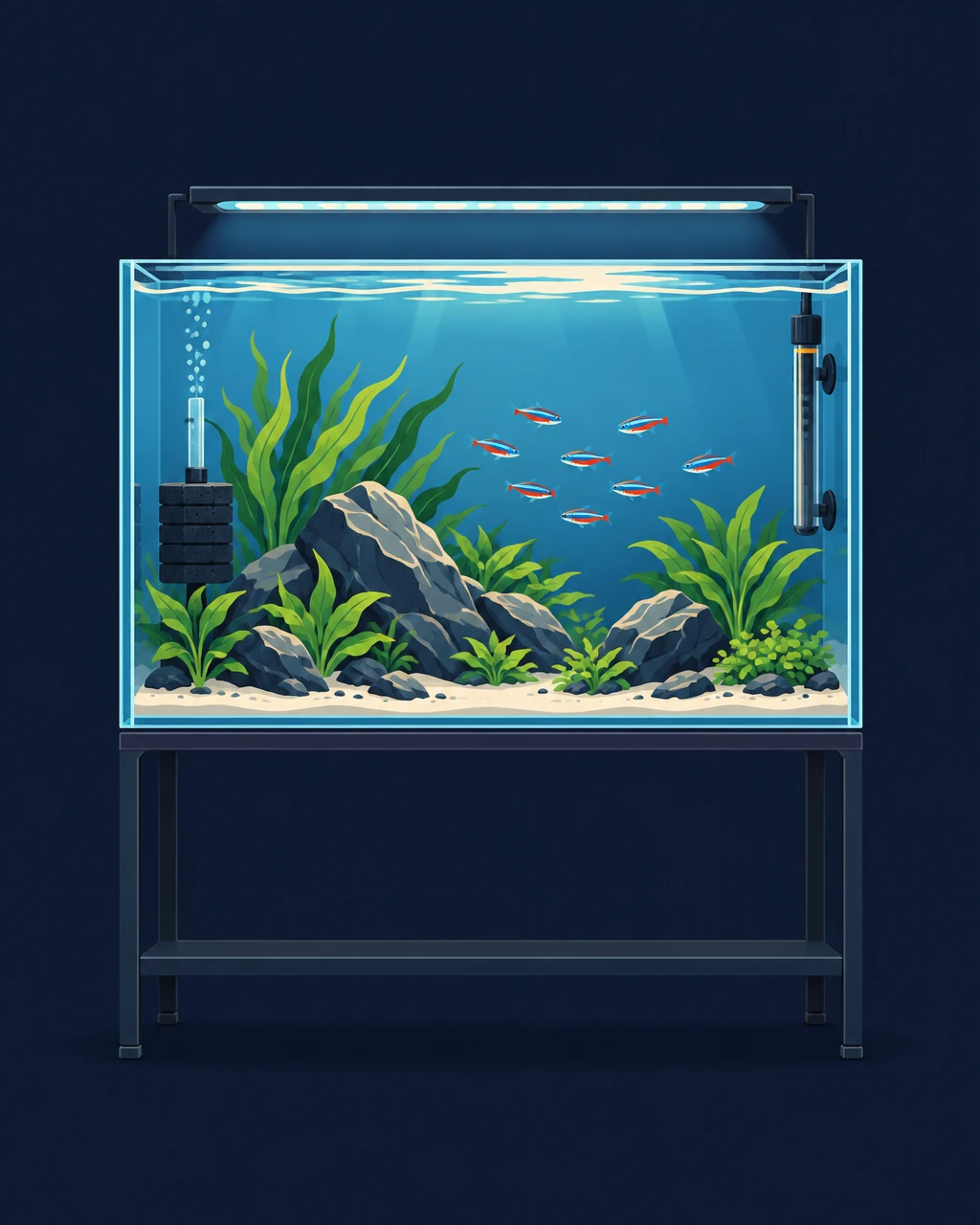
Longer than most people expect. A new tank needs time for helpful bacteria to grow in the filter, which is called cycling. The RSPCA advises at least two weeks with no fish, and says there's no exact rule. Test the water every other day, and add fish only after ammonia and nitrite have spiked and then dropped back to zero.
What size tank should I buy for my first tropical fish?
Go as big as your space and budget allow. Larger volumes hold steadier temperature and water quality, so they forgive more mistakes. The RSPCA advises a tank larger than 45 x 30 x 30cm, which is about 40 litres, and suggests allowing roughly 1.5 to 2 litres of water per centimetre of tropical fish length, excluding tails. Always check how big a fish grows before you buy it.
Do tropical fish need a heater and a filter?
Yes to both. The RSPCA says no fish should live in a tank without a well set up and maintained filter, and that tropical fish need a heater controlled by a thermostat. The right temperature depends on the species, for example 22 to 28°C for guppies and 18 to 26°C for loaches, so research before you buy. Check a thermometer every day.
How often should I change the water and test it?
Regular partial water changes stop waste building up. The RSPCA and the Ornamental Aquatic Trade Association (OATA) both point to roughly 25 to 30 per cent each week, depending on your fish. Treat tap water with a dechlorinator first, and match the temperature. Test for ammonia, nitrite, nitrate and pH regularly. OATA advises at least once a week.
Do you test water?
Yes. We offer water testing in the shop for aquariums and ponds. Ask the team when you call or visit, and tell us what's in the tank or pond and how long it has been running, so we can make sense of the result with you.
How do I introduce new fish to my tank?
Slowly. The RSPCA suggests turning the tank lights off and floating the bag in the tank for half an hour so the temperatures match. Then net the fish into the tank, throw away the bag water, and keep the lights off for the rest of the day. Add fish gradually too, because your filter bacteria need time to catch up with each new arrival.
Reef keeping
Marine and TMC
Are you a TMC stockist, and can you order in marine fish and corals?
Yes. We're an authorised stockist for TMC (Tropical Marine Centre), a marine livestock wholesaler founded in 1970, and we can order in stock directly from TMC's range. That range covers fish, corals and invertebrates. Availability changes and we can't promise a particular species at a particular time, so ask the team what's realistic for what you have in mind.
Are your marine fish wild-caught or tank-bred?
TMC's range includes tank-bred and cultured stock alongside wild-caught animals. What we have in changes, so ask the team what they can tell you about any fish or coral you like the look of. If sustainability matters to you, say so when you ask. It's a fair question, and a good one to put to any supplier.
Is a marine tank harder to look after than a tropical one?
Generally, yes. Marine tanks are less forgiving because salinity and temperature need to stay steady, so they suit people who are happy to test regularly and learn as they go. OATA advises testing at least weekly and adding fish slowly. Start with a well-researched plan, and talk it through with us before you buy anything.
How long should a marine tank mature before I add livestock?
Plan on weeks, not days. Marine guides commonly quote four to eight weeks for a tank to cycle, until ammonia and nitrite both read zero. Keep salinity steady too. OATA suggests a specific gravity of 1.024 to 1.026 where invertebrates are kept. Then add livestock a few at a time rather than all at once.
Garden ponds
Ponds and koi
How big and deep does a pond need to be for koi?
Koi grow large and can live for decades, so think big. UK pond specialists advise a depth of at least 90cm (3ft), and many keepers prefer 1.2m (4ft) or more, which helps the water stay steady and gives koi room to overwinter. More fish means a bigger pond. Talk to us before you dig, and plan for the koi's full adult size.
Why has my pond gone green?
Green water is caused by microscopic algae. They need light, water and nutrients, so a sunny pond, too much fish food or waste, and topping up with tap water can all feed them. Plants that shade the surface and use up nutrients help. A pump, filter and UV clarifier is the usual fix, because UV light damages the algae cells.
When should I stop feeding pond fish in winter?
Fish digest food more slowly as the water cools. Many pond keepers switch to an easily digested wheatgerm food once the water drops to around 10°C, and stop feeding when the fish stop coming up for food. Use a thermometer in the water, because pond water and air temperatures differ. Start again gently in spring as the water warms.
Can I keep a goldfish in a bowl?
No. The RSPCA says goldfish bowls are unsuitable. They're too small for a stable environment, too small for a proper filter, and their low surface area limits oxygen. Goldfish can live for up to 25 years and grow beyond 30cm, and the RSPCA says each needs at least 60 litres of water in a filtered tank, or a pond.
Vivarium pets
Reptiles
What do I need to have ready before I bring a reptile home?
Set the enclosure up first. You'll need a secure, ventilated vivarium of the right size, a heat source connected to a thermostat, suitable lighting including UVB where the species needs it, hides, fresh water and thermometers. The RSPCA advises running the whole set-up for at least a week before the animal arrives, so you can fine-tune heat, light and humidity.
Do reptiles need UVB lighting?
Many do, so check the species before you buy. UVB lets reptiles make vitamin D3 and use calcium, and a lack of it is a common cause of metabolic bone disease. The RSPCA advises UVB lighting for bearded dragons, leopard geckos and corn snakes alike. UVB doesn't pass through a glass window, so the lamp goes inside the vivarium, and tubes lose output over time.
How long do pet reptiles live?
Longer than many people expect. According to the RSPCA, leopard geckos can live for up to 20 years, bearded dragons usually live for 10 to 15 years or more, and corn snakes for around 10 to 15. That's a long commitment, so be sure before you buy. Think about who will care for the animal as your own life changes.
How big does a vivarium need to be?
It depends on the species, and bigger is better. The RSPCA suggests a minimum of 60cm long, 40cm high and 30cm deep for one adult leopard gecko, and 120cm long, 60cm high and 60cm deep for one adult bearded dragon. For a corn snake, allow at least a third of the snake's length for both width and height, so a 150cm snake needs about 150 x 50 x 50cm.
Furry and feathered
Dogs, cats, small pets and birds
Do rabbits, guinea pigs and hamsters need company?
Rabbits and guinea pigs do. The RSPCA says rabbits need at least one other friendly, compatible rabbit, and that guinea pigs are highly social and happiest in pairs. Hamsters are different. Syrian and Chinese hamsters should always live alone, and even dwarf hamsters don't need company to be happy. Ask us which combinations suit before you bring any home.
How much space and what food does a rabbit need?
More than a hutch. The RSPCA says two medium-sized rabbits need a living space of at least 3m x 2m x 1m. Their diet should be about 85 per cent fresh hay and grass, 10 per cent leafy greens and 5 per cent pellets, with unlimited access to good-quality hay. The hay also wears down teeth that never stop growing.
Can I feed my cat dog food?
Not as a regular meal. Cats are obligate carnivores and need a meat-based diet, so choose a food labelled complete for cats. Dog food is made for dogs, and regular feeding could leave your cat short of key nutrients. An occasional mouthful won't harm, but it's no substitute. Ask your vet if you're unsure what suits your cat.
How many treats can I give my dog?
The PDSA advises that treats make up no more than 10 per cent of your dog's daily food allowance, and that you reduce their usual meal by the same amount so they don't overeat. Natural treats count too. If your dog needs to lose weight, or you're unsure how many treats are sensible, ask your vet.
What size cage does a budgie need?
Big enough to flap fully. The RSPCA says that if a bird spends most of its time in the cage, the height, width and depth should each be at least twice its wingspan. Birds also need at least six hours a day out of the cage to fly safely indoors, and budgies, like most birds, do better with company.
Before you buy
Buying live animals responsibly
What should I think about before getting any pet?
How long it will live, what it costs, how much space and time it needs, and who will care for it when you're away. Lifespans can surprise people. The RSPCA says goldfish can live for up to 25 years, rabbits typically 8 to 12 and leopard geckos up to 20. The PDSA doesn't recommend pets as surprise presents, so involve everyone in the decision.
What are the five welfare needs?
The Animal Welfare Act 2006, which covers England and Wales, makes owners responsible for five needs: a suitable environment, a suitable diet, being able to behave normally for the species, being housed with or apart from other animals as appropriate, and protection from pain, suffering, injury and disease. It's a useful checklist before you choose any animal.
What should a pet shop tell me before I buy a live animal?
In England, pet shops need a licence from their local authority, and it must be clearly displayed on the premises. Ours is current and rated five stars. Licence conditions expect staff to advise you on feeding, housing and handling. For fish that includes water quality, and for reptiles the environmental conditions. You should also be given care information to take away. If anything is unclear, ask, and don't buy until it is.
What is your pet shop licence rating?
Five stars, the highest rating a local authority gives, and our licence is current. It covers the animals we keep, and it's displayed in the shop. If you'd like to see it, ask any of the team.
Where should I get a puppy or kitten?
From a breeder or a rescue centre, dealing with them directly. Under Lucy's Law, in force in England since 6 April 2020, anyone buying or adopting a puppy or kitten under six months old must deal directly with the breeder or rehoming centre. Pet shops can't sell puppies or kittens they haven't bred themselves. Ask to see the puppy or kitten with its mother, where it was born.
Keep exploring
More from the shop
How we can help
Still not sure?
Ask us. We'd rather answer one more question than have you guess. Ring the shop, message us on Facebook, use the contact form, or pop in and have a chat with the team.